Key Takeaways
- •Traditional productivity advice relies on executive function, which ADHD brains lack.
- •ADHD productivity requires external scaffolding, not willpower.
- •Break tasks down into microscopic steps to overcome paralysis.
- •Manufacture dopamine through novelty, urgency, or gamification.
Why Traditional Productivity Fails ADHD
If you have ADHD, you've probably read countless productivity books, downloaded dozens of apps, and tried every system under the sun. You might start strong for a few days, but eventually, the system falls apart, leaving you feeling guilty and defective.
You are not defective. The problem is that most productivity advice—like 'just use a planner' or 'do the hardest thing first'—was created by and for neurotypical brains.
Neurotypical productivity relies on executive function: the ability to prioritize, plan, initiate tasks, and regulate attention. ADHD is fundamentally a disorder of executive function. Telling someone with ADHD to 'just try harder to focus' is like telling someone without glasses to 'just try harder to see clearly.'
The Dopamine Deficit
At the neurological level, ADHD is characterized by lower levels of dopamine and norepinephrine in the brain's reward centers. This means tasks that aren't inherently interesting, novel, urgent, or challenging simply don't provide enough stimulation to activate the brain.
This is why you can hyperfocus on a new hobby for six hours but find it physically painful to spend five minutes paying a bill.
The 4 Pillars of ADHD Productivity
To be productive with ADHD, you must stop relying on willpower and start relying on external scaffolding. We can break this down into four pillars.
1. Externalize Working Memory
ADHD brains have poor working memory (the mental 'scratchpad' used to hold information temporarily). Do not trust your brain to remember anything.
Write it down immediately. Use voice notes, physical notebooks, or an app like MindMint to capture tasks the second you think of them. If it's not written down, it doesn't exist.
2. Lower the Barrier to Entry
Task paralysis happens when a task feels too large or ambiguous. Break every task down until the first step is ridiculously small and easy.
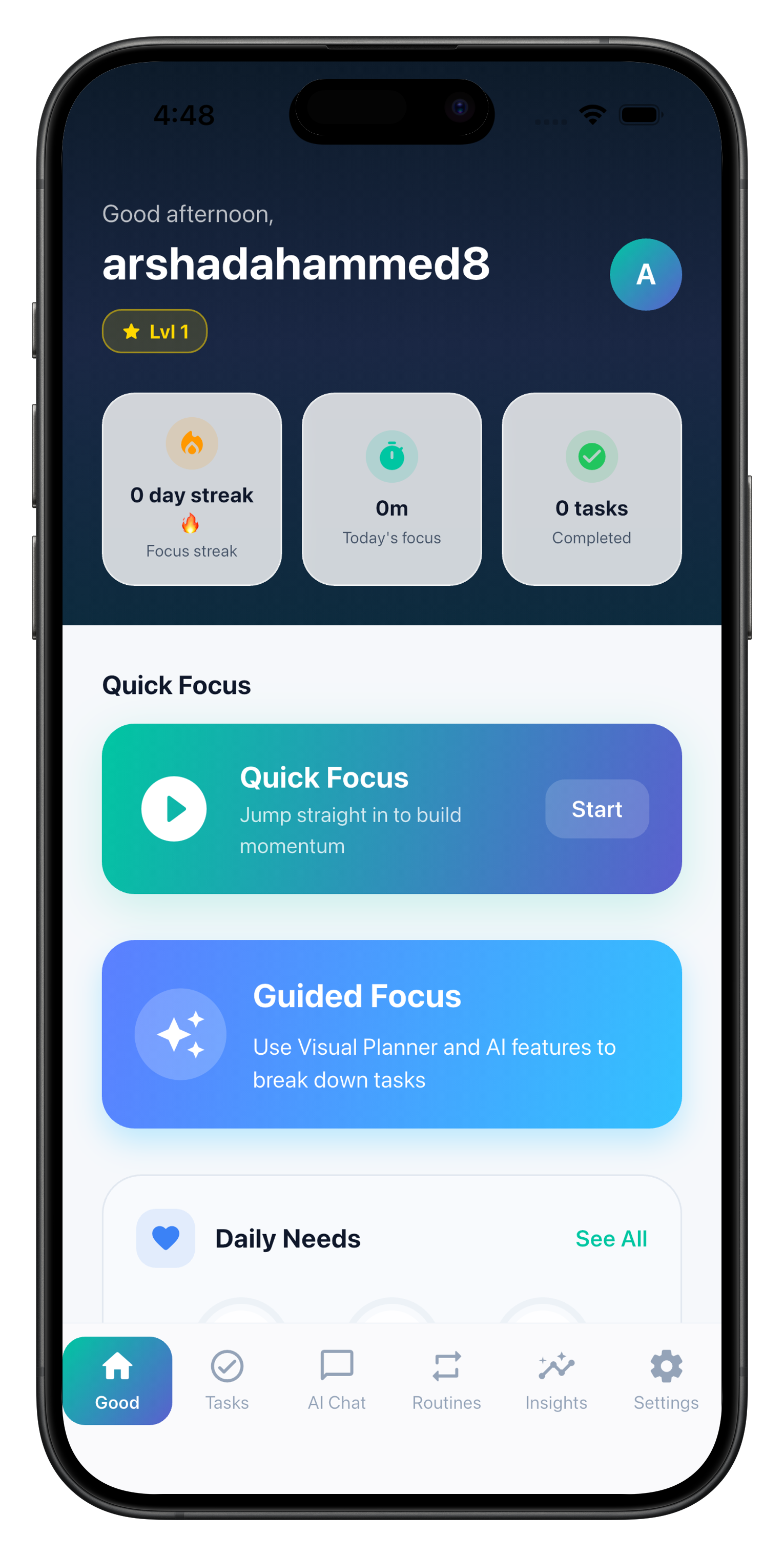
Don't put 'Clean Kitchen' on your to-do list. Put 'Put 3 dishes in the dishwasher.' Once you start, momentum often carries you forward. (MindMint's AI Task Breakdown feature does this for you).
3. Manufacture Urgency and Novelty
Since your brain doesn't naturally provide dopamine for mundane tasks, you have to create it. Gamify your work, set artificial deadlines, work in new environments, or use body doubling (working alongside someone else).
4. Forgive the Dips
Your energy and focus will fluctuate. Accept that you will have days where nothing gets done. The key is to avoid the 'all-or-nothing' spiral. If you mess up your routine on Tuesday, Wednesday is a clean slate.
Ready to Take Control of Your Day?
Join thousands of ADHD minds using MindMint to transform scattered thoughts into structured, productive days. Start for free today.
Frequently Asked Questions
Is it possible to be highly productive with ADHD?
Absolutely. Many highly successful entrepreneurs, artists, and leaders have ADHD. They succeed not by acting neurotypical, but by building systems that leverage their strengths (like hyperfocus and creativity) while mitigating their weaknesses.
Why do planners never work for me?
Because maintaining a traditional planner requires the very executive functions (consistency, working memory, task switching) that ADHD impairs. Digital tools that automate the planning process (like MindMint) often work much better.